 +91-9972 9926 11 / 7676 8932 33
 contact@r2sgreenwave.com / eco@r2sgreenwave.com

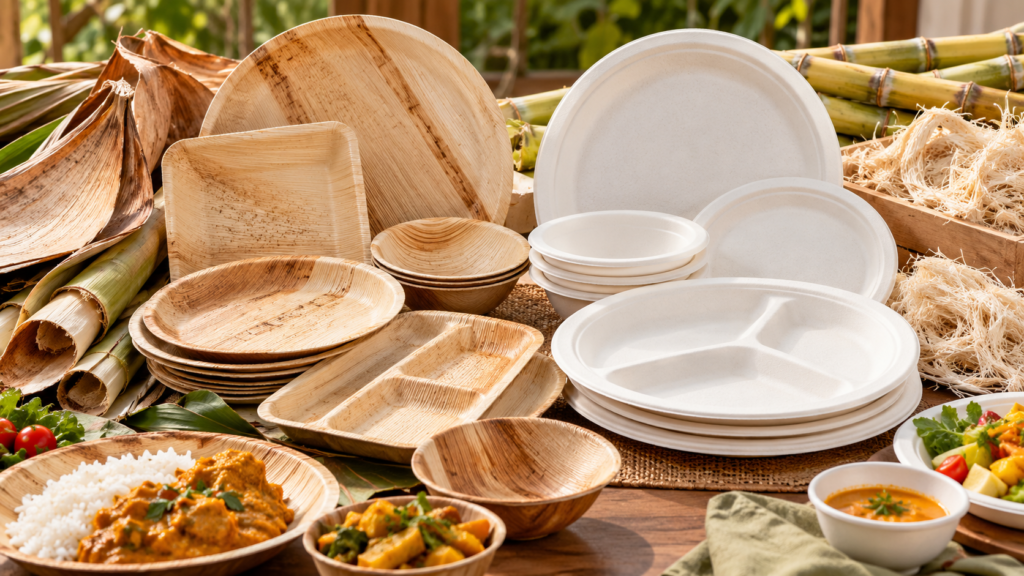
The global food-service industry is increasingly looking for alternatives to conventional plastic tableware. Two widely discussed plant-based options are areca leaf plates and bagasse plates.
But when comparing areca leaf plates vs bagasse plates, which is better?
There is no universal answer. The right choice depends on strength, appearance, food-service application, price, product specifications, sustainability requirements and customer expectations.
For international importers, distributors, wholesalers, HORECA suppliers and food-service businesses, understanding these differences can help identify the right sustainable tableware for each market.
What Are Areca Leaf Plates?
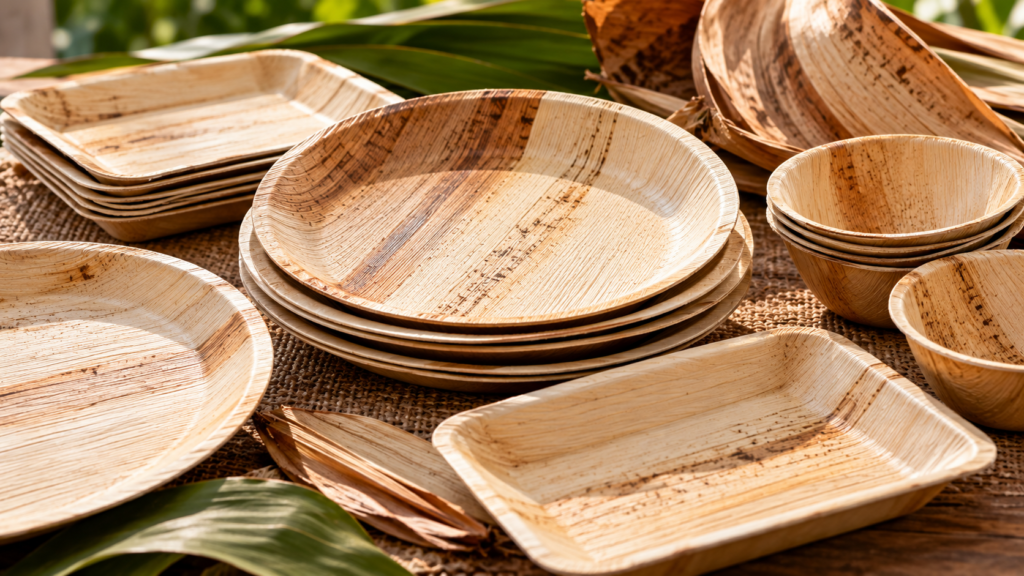
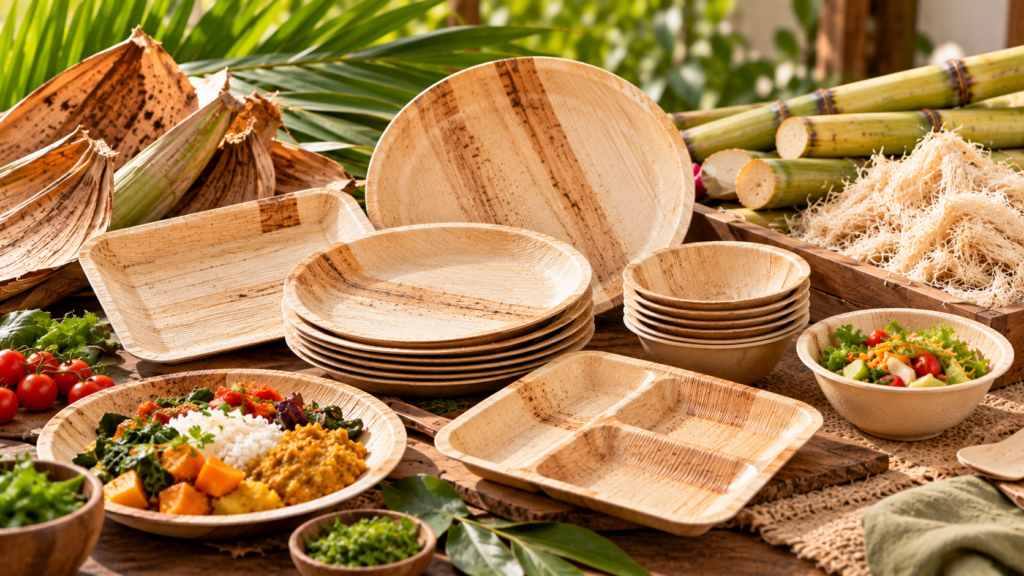
Areca leaf plates are produced from naturally fallen areca palm leaf sheaths. The material is cleaned, dried and heat-pressed into different shapes and sizes.
The process produces natural tableware with an authentic leaf texture. Natural variations in colour, markings and surface texture can make individual products distinctive.
Common products include:
- Areca leaf plates
- Round plates
- Square plates
- Rectangular plates
- Compartment plates
- Bowls
- Serving trays
This distinctive appearance makes areca palm leaf tableware particularly suitable for catering, hospitality, events, weddings and premium food presentation.
What Are Bagasse Plates?
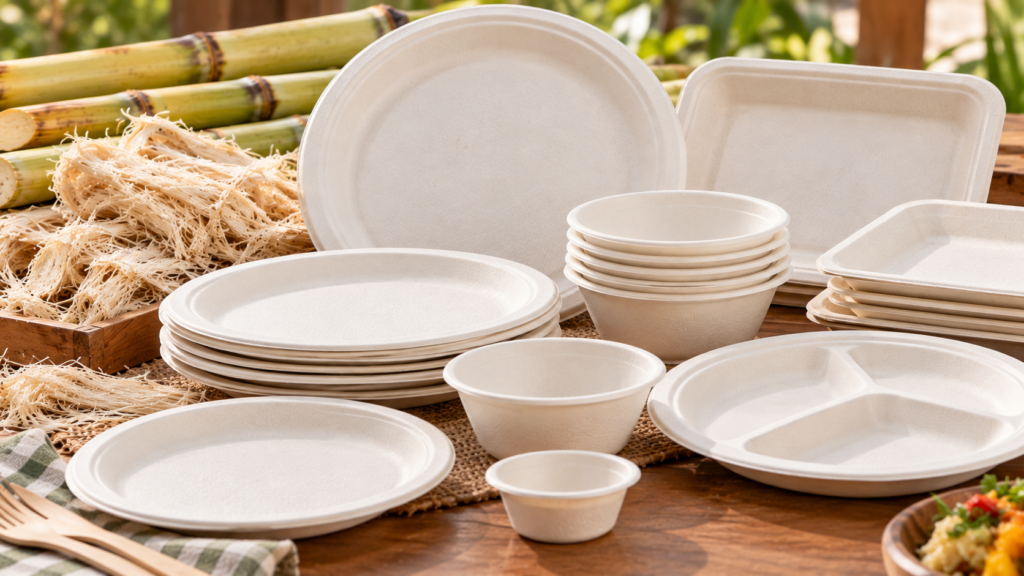
Bagasse plates are generally made from the fibrous residue left after sugarcane juice extraction.
The fibre can be processed into pulp and moulded into plates, bowls, trays and other compostable tableware products.
Bagasse tableware is widely used for restaurants, takeaway services, catering and institutional food service. Its moulded manufacturing process can produce consistent shapes and standardized products at scale.
Areca Leaf Plates vs Bagasse Plates: Key Differences
1. Appearance
Areca leaf plates typically have natural leaf markings, warm beige tones and subtle variations in texture.
Bagasse plates generally have a smoother and more uniform moulded appearance.
For buyers where food presentation and natural aesthetics are important, areca palm leaf tableware can provide a distinctive visual experience.
2. Material Origin
Areca tableware is made from naturally shed palm leaf material.
Bagasse tableware uses the fibrous residue generated during sugarcane processing.
Both are plant-based materials, but their manufacturing processes are different.
3. Strength and Rigidity
Strength is an important consideration when choosing disposable tableware.
Properly manufactured areca leaf plates can provide substantial rigidity because the natural leaf sheath is heat-pressed into shape.
Bagasse plates can also be strong, but performance varies according to fibre composition, thickness, mould design, product weight and moisture exposure.
For B2B buyers, actual product testing is therefore more useful than judging strength solely from the material category.
4. Areca Leaf Plates for Heavy and Multi-Food Meals
One practical characteristic buyers should evaluate when comparing areca leaf plates vs bagasse plates is structural stability.
Good-quality areca leaf plates can provide a firm and rigid eating surface suitable for serving multiple food items and heavier meals.
This can be particularly useful for buffets, catering, outdoor events, weddings, food festivals and standing food-service occasions, where customers may need to carry a plate while serving themselves and eating.
For example, a typical catered meal may contain rice, curry, vegetables, bread and grilled or fried foods. A rigid plate can make the meal easier to carry and handle.
Bagasse plates can also perform well under substantial food loads, but their rigidity varies significantly between products. Lightweight products may flex more when heavily loaded or exposed to moisture.
Therefore, buyers should compare actual samples under realistic conditions rather than making a blanket assumption about either material.
5. Food Presentation
The natural texture and warm appearance of areca leaf plates can create a rustic and premium food presentation.
Bagasse provides a clean, neutral and standardized appearance suitable for everyday takeaway, catering and institutional food service.
The appropriate choice depends on the customer’s expectations and the positioning of the food-service business.
6. Product Variety
Both materials are available in numerous formats.
Areca leaf tableware can include round, square, rectangular and compartment plates, bowls and serving trays.
Bagasse tableware is also available in a wide range of plates, bowls, trays and containers.
Buyers should therefore compare the specific product range offered by each supplier.
Buyer-Friendly Comparison
| Buyer Consideration | Areca Leaf Plates | Bagasse Plates |
|---|---|---|
| Material | Naturally fallen areca palm leaf sheath | Sugarcane fibre residue |
| Appearance | Natural texture and leaf markings | Smooth, uniform moulded appearance |
| Rigidity | Generally firm and rigid | Varies by specification |
| Heavy-food suitability | Well suited to many heavy/multi-food applications | Depends on product specification |
| Food presentation | Natural, rustic and premium | Clean and standardized |
| Product variety | Plates, compartments, bowls, trays | Plates, bowls, trays, containers |
| Typical applications | Catering, events, hospitality, buffets | Takeaway, catering, restaurants, institutions |
| Price positioning | Generally higher | Generally more economical |
| Material story | Natural fallen palm-leaf material | Sugarcane-processing by-product |
| Buyer priority | Natural appearance and rigidity | Standardization and cost efficiency |
Chemicals, Coatings and Additives: What Should Buyers Ask?
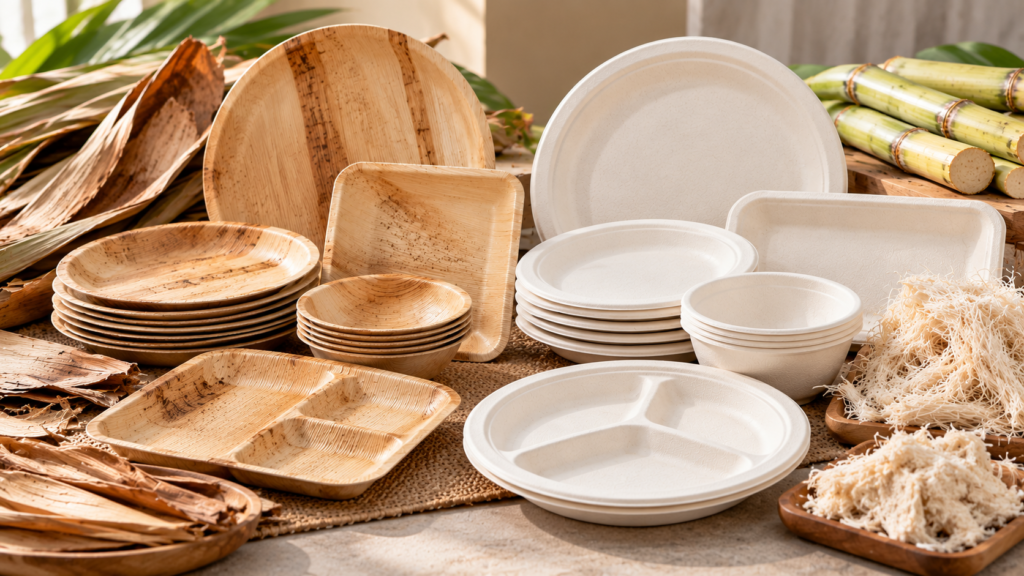
When comparing areca leaf plates vs bagasse plates, buyers should look beyond the basic material name.
Bagasse plates are primarily made from sugarcane fibre, but manufacturing processes can vary. Depending on the product, manufacturers may use processing aids, sizing agents, wet-strength agents, grease-resistant treatments or coatings to improve moisture resistance, strength or oil resistance.
Potential substances or substance groups used in fibre-based products can include AKD, ASA, wet-strength resins, starch-based additives, waxes and barrier coatings. Some food-packaging applications have historically used PFAS for grease and water resistance.
This does not mean that all bagasse plates contain these substances. Buyers should verify the actual formulation of the product they are purchasing.
Ask suppliers:
- Are any coatings applied?
- Are wet-strength agents used?
- Are grease-resistant treatments used?
- Are waxes or polymer coatings used?
- Are PFAS intentionally added?
- Are binders or other additives used?
- Is food-contact compliance documented?
- Can relevant test reports or declarations be provided?
For areca palm leaf tableware, buyers should similarly ask about the actual manufacturing process and whether any coatings, binders or additives are applied.
Avoid broad claims such as “bagasse contains chemicals” or “all areca plates are chemical-free.” A supplier-specific product declaration is more reliable.
Areca Leaf Plates vs Bagasse Plates: Which Is More Sustainable?
Sustainability involves more than simply identifying a plant-based raw material.
Both areca leaf plates and bagasse plates can provide alternatives to conventional plastic tableware. However, the overall environmental profile depends on raw-material sourcing, manufacturing, transportation, packaging and end-of-life management.
International buyers should therefore evaluate:
- Raw-material sourcing
- Manufacturing process
- Product composition
- Packaging
- Applicable food-contact requirements
- End-of-life options
- Local waste-management infrastructure
Using specific product information rather than generic “eco friendly” claims supports better sustainable sourcing decisions.
Which Should Businesses Choose?
There is no single solution for every food-service application.
Areca leaf plates can be particularly attractive when buyers prioritize:
- Natural appearance
- Rigidity
- Heavy or multi-food applications
- Premium food presentation
- Catering and events
- Hospitality
- Natural material aesthetics
Bagasse plates can be attractive when buyers prioritize:
- Competitive pricing
- Standardized formats
- Large-volume food service
- Consistent moulded appearance
- Everyday takeaway applications
For distributors and importers, evaluating both categories can be more useful than treating them as direct substitutes.
What Should International Buyers Check Before Importing?
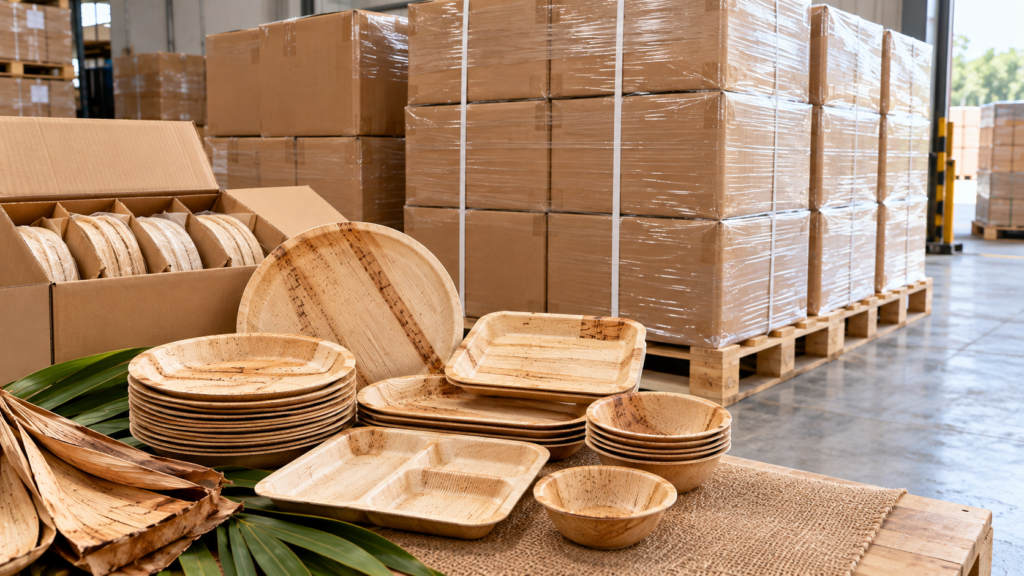
Before purchasing eco friendly plates in commercial quantities, request samples and evaluate the actual products.
Check:
Quality: Thickness, rigidity, finish and consistency.
Food performance: Test with heavy, wet, oily and hot foods relevant to your market.
Packaging: Examine carton configuration and protection during transportation.
Storage: Consider warehouse humidity and protection from moisture.
Specifications: Confirm dimensions, product weight, pieces per pack and carton quantities.
Supplier capability: Verify production capacity and consistency.
Export readiness: Discuss documentation, Incoterms, shipping configuration and delivery requirements.
The Bottom Line
The comparison between areca leaf plates vs bagasse plates is not simply about deciding which material is universally better.
Areca leaf plates offer a distinctive natural appearance and can provide excellent rigidity for many food-service applications, including heavy meals, buffets, catering and standing food-service occasions.
Bagasse plates offer a standardized plant-fibre solution that can be highly competitive for large-volume everyday food service.
For international buyers, the right choice should be based on application, product performance, customer expectations, specifications, pricing and sourcing requirements.
At R2S GREENWAVE, we work as an Indian merchant exporter and export sourcing partner, helping international buyers explore areca palm leaf tableware for global food-service markets.
For buyers evaluating sustainable tableware, the best starting point is to compare actual samples and specifications rather than relying only on material labels.